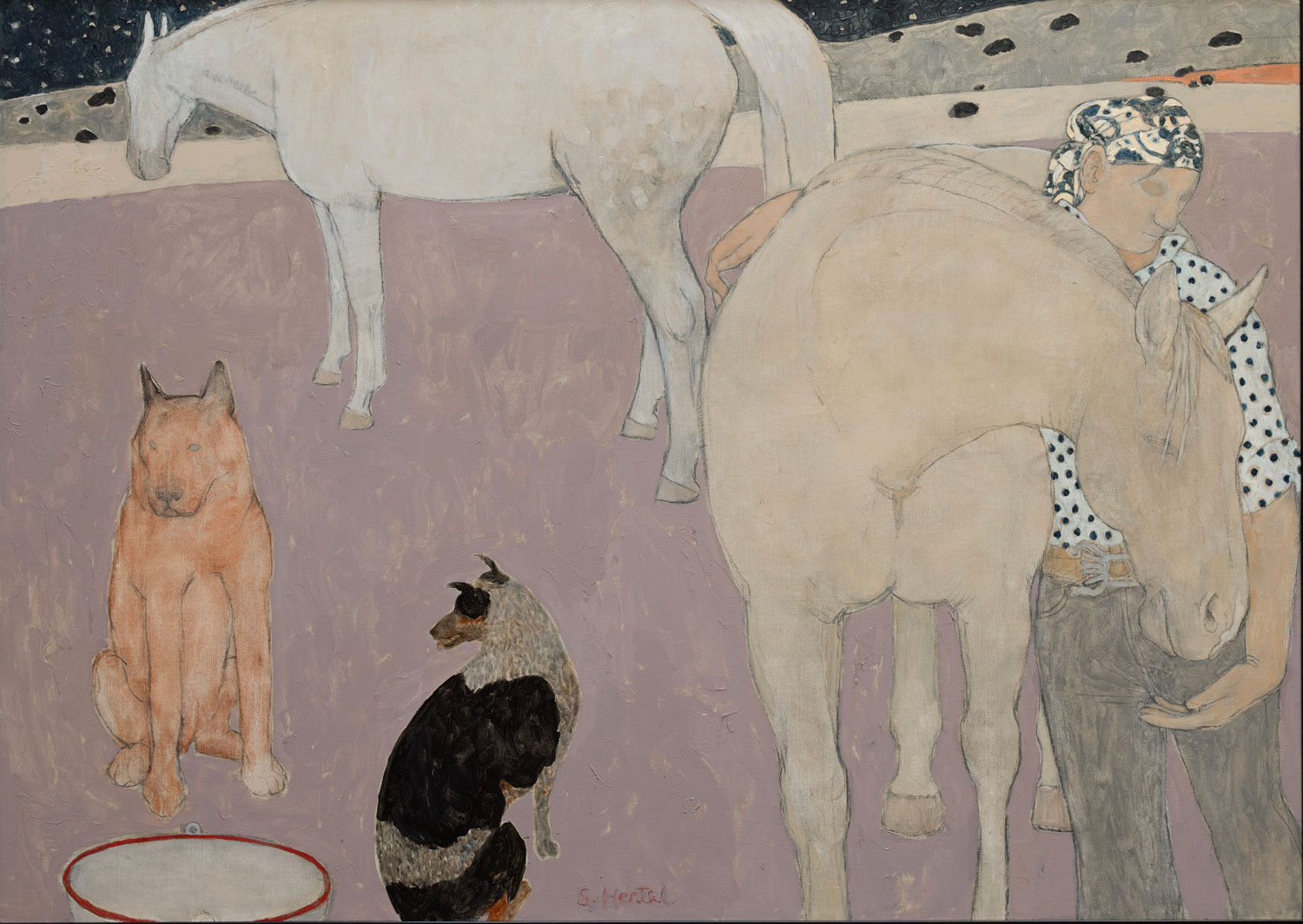
Susan Bright Lautmann Hertel was born July 19, 1930, in Evanston Illinois, a twin daughter of Herbert Moses Lautmann and Edith May Shultz Lautmann. One of four siblings, Susan grew up in Highland Park, Illinois outside Chicago. The family spent summers at Lake Geneva Wisconsin and later in Arizona. Throughout these experiences, Susan became deeply attached to both the natural world and Native American life. Her early interest in horses is manifested in voluminous childhood sketchbooks from classes at the Chicago Art Institute.
In 1948 Hertel studied art at Scripps College in Claremont CA. under Millard Sheets for whom she would later work as studio assistant. A twenty-six-year collaboration followed including the production of public murals, sculpture, architectural works, and stained glass. Hertel consider painting to be her primary focus throughout, developing a style that leaned heavily on her skills as a muralist. Working from photographs Hertel would begin with drawings and gouache color sketches, working through compositional arrangements, which would lead her to full size oil paintings. Hertel exhibited with Elaine Horwitch in Santa Fe, Ankrum Gallery, Los Angeles, and with Barbara Beretich Gallery in Claremont California
Of a trip to Europe in 1955, she recalled: “The most important thing happened just days before I came home. In Paris, I saw my first Bonnards. They opened up a whole new wing for me. Here was a painter who organized shapes and patterns in a way that was completely compelling to me, and his subjects were from his own personal environment. That, I realized, was what I wanted to paint also.”
Susan became the artistic assistant to Millard Sheets who was expanding his career into architectural works, stained glass, sculpture, and mosaic murals. This was to begin a twenty-six-year collaboration, which led to the design and production of many significant works throughout the United States. All the while, she continued as a painter and until her death regarded this as her primary work as an artist. Adapting a method she had developed in the production of public murals, Susan used photographs of her family and animals as a starting point for drawings and gouache studies, in which she arranged and rearranged compositions in preparation for each full-sized oil on canvas painting. In 1958, Susan married artist/teacher Carl Hertel and eventually established Barking Dogs Ranch in the Glendora foothills. They raised five children, Arabian horses, Nubian goats, dogs, cats, chickens, and various other animals, all of which came to dominate her imagery of that period.
In 1980, with their children mostly grown and out on their own, Susan and Carl moved to Cerrillos New Mexico, where they built corrals for the horses, a studio for Susan, and lived in a small passive solar adobe. Susan’s paintings were exhibited at Elaine Horwitch Gallery in Santa Fe along with Ankrum Gallery in Los Angeles. She continued to design murals for Denis O’Connor, who directed the studio in California after Sheet’s retirement. In 1987, after surviving breast cancer and divorced from husband Carl, Susan settled in her own house and immersed herself in painting, and writing poetry. She became an activist for local environmental causes, sang folk songs with rancher neighbor Archie West, and was embraced as extended family by Rina Swentzell’s family of Santa Clara Pueblo, among other friendships that formed and sustained her. Susan left mural work and was free to work literally day and night on her own paintings and with her horses. The spacious landscape and depth of tradition resonating throughout Northern New Mexico came to strongly influence her work.
“Beginning in 1984 and continuing for the next seven years, Susan enjoyed the most productive time in her artistic career. She made large paintings in which color expressed a sense of exuberance and joy… In 1991 when the cancer, which had been in remission, returned in her lungs, she eschewed chemotherapy for holistic healing. Although at times she felt her energy waning, she kept painting and produced some of her most emotionally powerful works, which were ambitious in scale and innovative in composition. “ - Mary MacNaughton
Susan died of cancer at her home near Cerrillos on March 10, 1993. Her work remains as a reflection and as a memorial to her remarkable life and to the love of animals and nature, which permeated that life. As Carl Hertel commented, “Art for Sue was part and parcel of her spiritual journey. Indeed, she found within each of her daily projects-whether it was painting, writing poetry, riding, or feeding her animals-profound joy in the experience of living and a deep connection with the universe of living things”.
In Susan’s own words, “My ideal in painting, is that moment when what’s every day is seen as magical… To me, that’s what a painting can do, if it wants to, when it works (or music or any of the other arts). It can take that magical complexity and lead it into an inevitable, unquestionable simplicity and array the spirit. That’s what I’m working towards…”
Comara Gallery, Los Angeles, CA, 1962
Comara Gallery, Los Angeles, CA, 1964
Westwood Gallery, Los Angeles, CA, 1963
Pasadena Museum of Art, Pasadena, CA, 1967
Long Beach Museum of Art, Long Beach, CA, 1969
Scripps college, CA, 1974
Gallery 8, Claremont, CA, 1976
Gallery 8, Claremont, CA, 1978
Elaine Horwitch Gallery, Santa Fe, NM, Sedona, AZ, Scottsdale, AZ, 1983-1993
Claremont Lewis Museum of Art (Claremont, CA)
Ruth Chandler Williamson Gallery (Claremont, CA)
Monday - Friday
9:00 am - 5:30 pm
Evenings & weekends
by appointment


Monday - Friday: 9:00 am - 5:30 pm
Evenings & Weekends
by appointment
.png)